Sunday, 8 August 2021

Marchmont


Yesterday Benedict Ambrose and I went on a trip to Edinburgh's Morningside. We started, however, by buying two bacon rolls from a nearby cafe. I was interested in the fact that they cost £2 each, but B.A. was   much more interested in their (to him) excellence: soft white rolls; salty, lightly fried back bacon. Bacon rolls are a Scottish national dish. 

We went a certain distance by the Rough Bus, and I silently wondered at the black teeth of the young lady in the seat in front of us, and we alighted the stop by a certain pub so as to walk in the leafy, rather grand Marchmont neighbourhood. Marchmont abounds in enormous four storey stone Victorian houses, riotously floral front gardens and hidden back gardens of (I imagine) indescribable lusciousness. There is also a Michelin-starred restaurant, about which more anon. For the time being, we were walking to the Gillis Centre, which is where the Archdiocesan offices are,  The oldest buildings, including a large chapel, were designed by James Gillespie Graham and finished in 1835. 

Today there is also a young apple orchard and yesterday a group of pretty, slim young women, including two nuns, sitting on chairs in a circle near the rosary chapel. B.A. recognised one of the girls by her bright hair, and we pondered, in our gossipy middle-aged way, what cause the group was serving. Nobody expects the McLeans just to turn up at the Gillis Centre and sit on a bench, but there you go. The only time  I ever went to Morningside in a miniskirt, I ran into an older person, and it was all over the  parish news by Sunday. Don't trust anyone over 45, that's what I say. 

Anyway, after we tired of our bench, we continued our walk, luxuriating in the stately row houses and their bright gardens, walking past the Archbishop's Palace and its wreckovated chapel, and heading towards cozy Morningside. We popped into charity shops, making me feel ten years younger, but did not buy anything until we sailed into Waitrose. In Waitrose we bought a couple of pastries to eat on a bench; tea we had brought with us in a thermos. (We also bought a couple of small ersatz 'cannoli' in a new, very not-Italian pastry shop, and only honesty compels me to confess this.) 

B.A. informs me we have to leave for Mass in 15 minutes, so I will say only that we walked back though Morningside and then Marchmont to get our bus, and when we got home I made peanut butter brownies again. It was a very nice way to spend the day.

And yes, the Motherwell TLM has been totally cancelled, and I look forward to soon meeting the discommoded faithful young families being punished for their attachment to Catholic tradition.

Saturday, 7 August 2021

Small Economies


Today let us meditate upon the Gospel according to Matthew, Matthew 6:25-29 (King James Version), to be precise:

Therefore I say unto you, Take no thought for your life, what ye shall eat, or what ye shall drink; nor yet for your body, what ye shall put on. Is not the life more than meat, and the body more than raiment? Behold the fowls of the air; for they sow not, neither do they reap, nor gather into barns; yet your Heavenly Father feedeth them. Are ye not much better than they? Which of you by taking thought can add one cubit unto his stature? And why take ye thought for raiment? Consider the lilies of the field, how they grow; they toil not, neither do they spin: and yet I say until you, That even Solomon in all his glory was not arrayed like one of these.  

What I find fascinating about this today is that my own maternal culture, in which you can participate by reading Lucy Maud Montgomery's Anne novels*, has all this off by heart (and according to the KJV) but also thought a good deal about eating (without waste), drinking (without drunkenness),  raiment (no sparkling gems before 5 PM), toiling (Protestant work ethic), spinning (as it were) and putting money by for a rainy day. 

Summoning to mind my paternal culture, I can see only approved way of living to the letter of Matthew 6:25-29, and that is in a monastery. If you're trying to do this outside of a monastery, you may be a dirty hippie, not that we would ever be so rude as to say so. 

I'm amused by the contrast between Matthew 6:25-29 and my money-haunted devoutly Christian cultural backgrounds. It is one of the interesting tensions of life---although, admittedly, it is more painful than interesting when I burst into tears because I have to buy something costing £29.99 for work and I won't be paid back until September. It's not even because we'll be in the red at the end of the month (I think); it's that there will be less green. 

That's the downside of getting so tremendously excited about household accounts. 

There are rewards, though. Yesterday I enjoyed a quiet and relaxing quarter-of-an-hour sewing up the holes in the toes of my blue striped socks. Then I shined my navy blue granny shoes, to make them look newer to the physio. In the evening, my heart rejoiced when Benedict Ambrose, after scouring Gumtree for a bargain on ergonomic chairs, illustrated that the one I bought four years ago is not, in fact, broken. 

"You fixed it," I cried, delighted to have saved a minimum of £60.

'I didn't fix it; I used it," he grumbled. 

I am currently saving more money by writing on a desk that is too large for our dining-room but turns out to have (as I had forgotten) a drawer that folds out into a typing table. I would like to rid myself of the behemoth, but then I would have to buy a new one, and it would cost more than free.  

Such small economies warm my descended-from-several-generations-of-Scots-Presbyterian-women-and-a-1969-Catholic-convert heart. My parents are, naturally, also good at small economies, and the photograph illustrates one of them. 

I cannot remember on what occasion I cravenly suggested to the earthly authors of my being that they  give me an iconic Hudson's Bay Company blanket. Perhaps I suggested it as a hostess present: what a stinker. The HBC blanket, white wool with those stripes, is evocative of the Canadian Dream, which is to own a cedar-smelling cottage in the woods by a lake. It costs a bomb, which is to say, $325-$450, but in my defence I didn't know that when I hopefully asked my Aged Parents to bring us one.

The Aged Parents cleverly divined that the Canadian nostalgia I was looking for was contained not in the white wool but in the stripes. They therefore sent or brought us a tall ceramic coffee mug emblazoned with the HBC stripes. It is too lovely to shut away with the other coffee mugs, so we use it for our everyday silverware.  

It stands on the kitchen counter, not only an evocative symbol of Canadiana, but also a tribute to my parents' good sense. If we had to flee with only 100 possession in a suitcase, I would certainly pack that mug.

This may be as good a time as any to admit that the Made-in-Scotland fine wool blue cardigan my mother gave me for Christmas has worn a hole in the left elbow. Benedict Ambrose, who keeps his clothes pristine for decades, says this is because fine wool cardigans are not suited to everyday use. He suggested I buy smart leather patches to cover the elbows, but I have saved us £4.50 or so by simply sewing up the hole with blue thread. 

*I'm not even kidding about the Anne books, the literary distillation of Scots-Canadian Presbyterianism. And I will now once again indulge myself by repeating that the Woke generation, like my own PC generation, will never be able to write The Great Canadian Novel, for it has already been written and it is Anne of Green Gables. 

Ha ha ha ha ha ha ha!

Friday, 6 August 2021

The Fallout


News drifted from nearer the west coast: TLM restricted. 

There were, of course, lightning-fast reports from England and America: bishops quick to chide or swift to bless. But matters in Scotland are being settled more slowly, hopefully with a good deal of thought and even more prayer. Those who have the most to lose are reluctant to say much in public. Nobody wants a kind bishop punished for his goodness or a craven one rewarded for his ... compliance. 

I got the message while on my way to the physiotherapist. There was fallout there, too, of a milder kind. I must stop typing on my laptop. I must buy a new ergonomic desk chair. I must do my arm-strengthening exercise. My physio doesn't want me to keep coming in. She wants me to get better. 

Unlike the new restrictions on the TLM, these instructions were to help and heal. 

As nothing glues together a community like rejection from the outside, traditional Catholics are likely to become even more united with each other. This could be bad as well as good, for we run the risk of becoming insular and overly eccentric, and thus unattractive to Catholics seeking respite from the baby-talk homilies the camp priests, the bullying lay ministers, and congregations' self-worship. 

"Body of Christ, Glenda!"

"Ay-MEN, Tracy!" 

I hope, therefore, that we have the grace and the hope to sing the Te Deum as we leave our old churches and find refuge where the TLM is allowed. In Scotland, this could be quite nice, even, as new young people mix and mingle, bringing friends or girlfriends from different universities (despite their chaplains' screams). There will probably be more weddings and then more babies, and our numbers will grow even more. 

Our cups will flow over, and eventually even the pandemic will end, and I will be able to serve after-Mass tea once again.   

Update: Meanwhile, in Argentina....

Thursday, 5 August 2021

Laundry


In my patch of neighbourhood, laundry is not a dull or mindless task. It is dependant on the weather because nobody has a dryer. You can tell because on sunny days every back garden has darks, brights and whites hanging or flapping on the clotheslines. 

B.A. has a theory that once upon a time, when all the buildings belonged to the Council (e.g. local government), the back gardens were one vast drying green. This thought is not farfetched; most neighbourhoods like ours have drying greens, and not private gardens. The point is not the green grass (or hard concrete) underfoot but the plastic-coated wire above. Energy bills are expensive.  

Our washing machine is small, but I try to keep loads to three a week: whites, darks, brights. These days it is usually Benedict Ambrose who fills up the big blue Ikea bag with wet clothes and hangs them up outside. It's a task I enjoy, though, as I like pinning them up in a logical order, using the most economical number of pegs--except for socks. I like every sock to have its own peg. It is also social, not only because neighbours come out to say hello, but because I can see all the neighbouring laundry.

It is usually B.A. these days who takes them down, too. I like this task less because I find the wrinkles depressing. 

Last weekend I went to the closet and packed three bags full of old clothes, two for the charity shops and one for recycling. After 16 months of a pandemic, there were many, many clothes I had not worn for a year, one of the rules of thumb for wardrobe-thinning. There were some sad good-byes: a green corduroy jacket, a blue evening bag, a funny 40th birthday gift (see above), a grey-blue gown with poppies and other field flowers embroidered all over the gauzy front layer. I never actually wore this dress anywhere, and it is a happy accident that I did not wear it to Polish Pretend Son's wedding because Polish Pretend Daughter-in-Law's reception dress was embroidered with poppies and other field flowers. But mine was the prettiest dress I never wore, and packing it in a bag felt like shutting a door on--what? A younger, thinner, more embroidered self probably. 

The reward for divesting myself of all this cloth was more space in the closet, an empty small suitcase and a nearly empty large suitcase.  I could have pruned harder--and ideally I would like the minimalist wardrobe of a navy blue nun--but the thought of getting rid of any cardigan that did not actually have holes in the elbows made me strangely nervous. 


Wednesday, 4 August 2021

Languages on the Beach


Yesterday I fulfilled three of my daily goals by going to the beach to speak Polish and English to my language exchange partner. (The goals are spending time outdoors, exercising, and practising foreign languages.)  

It was a lovely sunny day, and my language partner told me about her weekend and her career thoughts. I told her about Monday's excursion and once having spoken to Cardinal Dziwisz in a Kraków street. We also exchanged thoughts on generational differences when it came adherence to Catholicism. I am less clear on what we talked about in English, but I hope my language partner found it profitable. 

Eventually we walked over to where B.A. was sitting, exchanged greetings in English with him, and said our good-byes. I then walked all the way home with B.A. (who had walked all the way there) and felt rather too tired to start work. Nevertheless, to work I went. 

Work involved hours and hours of transcribing rapid American medical opinions about COVID-19, its treatment and its vaccines. As my interview subject had described various do-it-yourself prophylactic methods, I was quite terrified that if I misheard and therefore wrote the wrong words, readers might take the wrong thing and do themselves an injury. I also looked up the medical use of very, VERY dilute sodium hypochlorite, and it is actually a thing. (But for heaven's sake, I beg everyone not to swig bleach.) 

Presumably because once I protested the arson of Catholic churches in Canada on Twitter, someone tweeted me her opinion that Catholics must tell Pope Francis to apologise for Canada's residential school program. She was not happy when I tweeted back that Pope Benedict apologised for Catholic involvement in Canada's residential school program (which ended before I was born) in 2009. 

The young woman also did not enjoy my reflections on child mortality rates before WW2, Jane Eyre, and my inability to find my great-great-grandfather's gravestone, possibly because his widow couldn't afford one. Neither did she enjoy Tomson Highway's account (to which I tweeted a link) of the wonderful time he had in residential school. 

Unsurprisingly this led to the young woman calling me a racist and ascribing me "Catholic guilt" (that is, a new mark of Cain Catholics apparently bear). Rather more surprisingly, she said she had made a donation to the preservation of a residential school in my name. She said she hoped I'd enjoy it, so I will certainly swing by the next time I am in that part of Ontario and have a look. It was run by Anglicans.

I found her behaviour strange, but then I have been relatively lucky in avoiding online abuse---presumably because, in my blogging heyday, I hit the "Delete" button in the comments section without an iota of guilt.  I also find it sad because she clearly hates Catholics and may even think that this hatred is a way to flourish as a person.

In my experience, dwelling on historical injustices isn't psychologically helpful. To give one very minor example, I very much resented being reviled as a "mangiacake" by Italian-Canadian kids in my elementary school and I glommed onto a new friend's disdain for the Italian-Canadian subculture known in the 1980s as "Ginos and Ginas." Today this does not sound much different from calling someone a Guinea, but it seemed perfectly fair back in the 80s, when there were Ginos, Ginas, metalheads, mods, punks, goths, et al. Anyway, to sum up this very old story, I was rescued from this unpleasant habit of mind by taking Italian classes. [A more general example would be that of the young woman who decides from unfortunate early experiences that "men are scum" and then discovers Mr Right only after abandoning her radical feminist separatist commune.)

I'm not sure what I would suggest for my critic, though. Hearing both sides of the story--FN stories of love and success as well as FN stories of abuse and trauma--might be helpful.  

Tuesday, 3 August 2021

Likeable Children


Our pupils suffered an acute Covid regulation-related disappointment, so their maths teacher and I met them yesterday for another excursion. It was a beautifully sunny Bank Holiday Monday-- a marvellous day to be outside, marching children to lunch and then to historical sites, full of food and education. 

I think we all had a very good time. My colleague insisted in ordering escargots so that the children could try them. They tasted like rubbery mushrooms. The children, unsurprisingly, were underwhelmed, but at least they can say they have eaten snails (or A snail) and perhaps they will remember, even unto old age, a sunny day in Edinburgh, the 16th century apartment building, cappuccino or hot chocolate in the hidden park off the Royal Mile, the threat of being thrown into one of the pools outside the Scottish parliamentary buildings. 

This morning I remembered a video of Jordan Peterson talking about how necessary it is to raise your children so that adults will like them. This is absolutely true, not only because (as he says) adults will smile at them honestly and make them feel welcome in the world, but also because adults will be happy to take them off your hands for a few hours and (if you have introduced the children to the right adults) impart your values to them from another direction. At the same time, such adults can expand their horizons in beneficial ways: feeding them snails, talking of other countries, exhorting them to save 50% of all money that comes their way, explaining the talent vs practice debate. Normally these adults would be uncles and aunts, I imagine.  

When I got home, shedding hat, mask, and even hair elastic on the way from the railway station, I found B.A. reading a magazine and drinking elderflower champagne on the little porch at the top of the stairs overlooking the garden. I was so tired I just plunked down on the stairs and drank from his glass. He very kindly got me a chair and some peanuts and put another bottle of elderflower champagne to cool in the freezer. So I sat with my back to the sun, which kindly warmed up my head, and was enormously grateful to be so tired in such a good cause. 

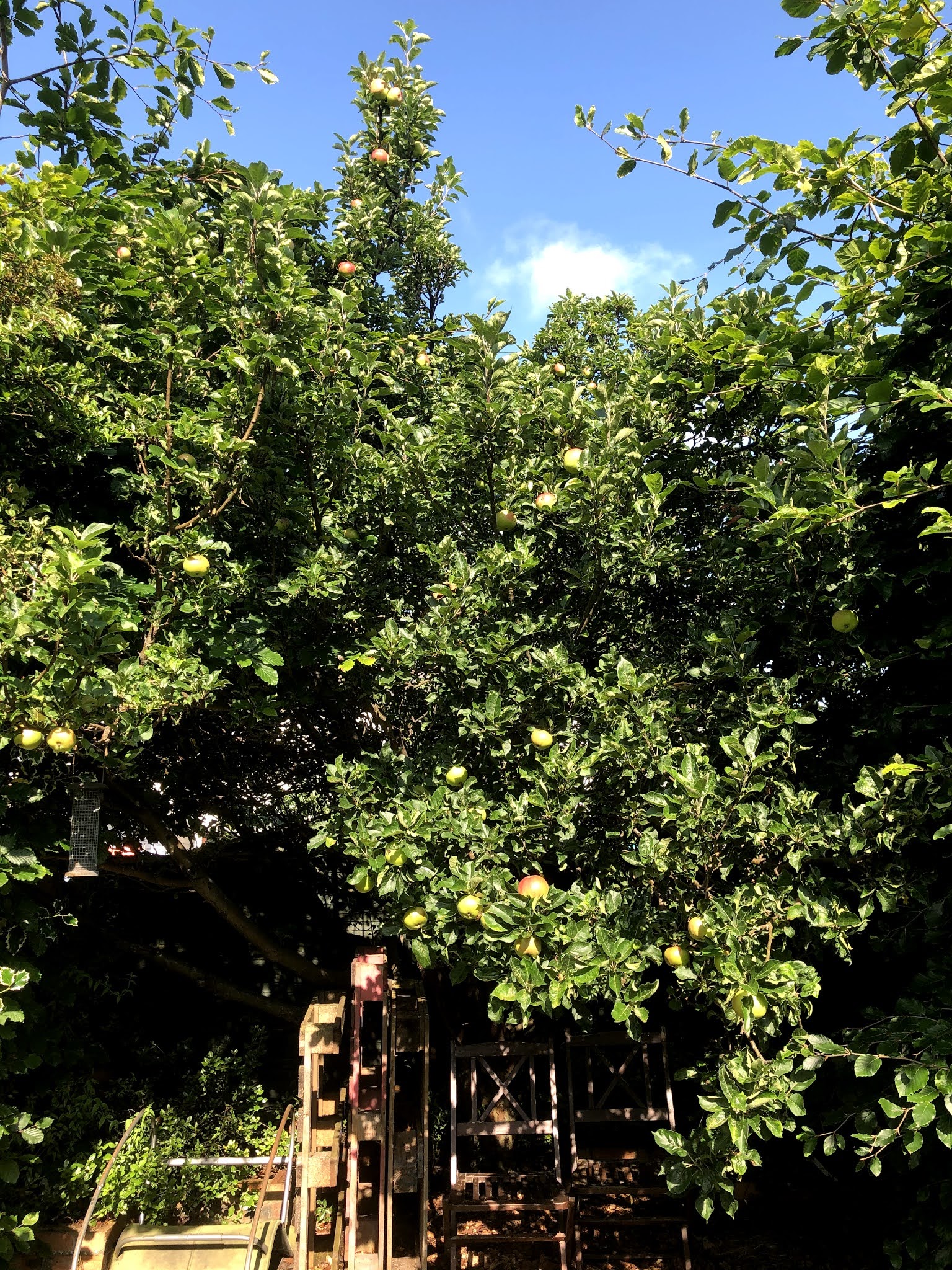
The photo is of our apple tree yesterday. I think I will start posting apple tree photos to mark the passage of the seasons, now that I am properly blogging again. 

Monday, 2 August 2021

Excellent Brownies


Good morning! I am posting my new peanut butter brownie here so that I can easily find it later. Last week I went to the internet to find my old banana bread recipe and, lo, the only place in the web it was lodged was Seraphic Singles. 

First, credit where credit is due: this excellent recipe is from "And Also the Crumbs Please". The one difference is that I halved the recipe to fit into my 20cm (8"x 8") tin and feed two people for no longer than 3 days. If you have children and a 9" x 13" tin, you should use the original recipe (link above). However, if you are making these for a grown-up dinner party (which I recommend), stick to my recipe.

Peanut Butter Brownies (8 big pieces)

Chocolate part

1/2 cup melted butter, cooled 

1/2 cup granulated white sugar

1/2 cup brown sugar

2 med-to-large eggs

1 tsp vanilla extract

1/2 cup plain flour (UK okay) via dip-level-pour method

1/2 cup good (e.g. Green & Blacks in UK) cocoa

1/2 tsp salt

2 oz/60 g of dark chocolate bar (Tesco okay) broken into small pieces

Peanut butter part

1/2 cup 100% peanut butter (mix it up in the jar with a spoon before measuring)

1/8 cup melted butter, cooled

1/4 sifted (or sieved) icing sugar

1/4 salted peanuts (B.A. hides ours, so I had to leave the kitchen while he got them out)

Instructions

1. Preheat oven to 350 F/180 C.

2. Line 20 cm square tin with enough baking paper so that you can pull it out afterwards.

3.  Just blend the butter, sugars, eggs, and vanilla with a whisk.

4. With the whisk, stir in the flour, cocoa and salt until just combined, and then fold in the small chocolate pieces. Too much stirring is bad, apparently, making the brownies more "cakey" and less moist. 

5. Clean off the whisk to whisk together in a separate bowl the peanut butter, 1/8 c melted butter and icing sugar. Then fold in the peanuts. 

6. Randomly throw big spoonfuls of the chocolate batter and the peanut butter batter into the pan. 

7. Draw a swirl through the batter with a knife, but don't mix it up. 

8. Put the tin in the oven and bake just until it no longer jiggles when you shake it. For my oven, that was exactly 30 minutes. Start checking at 23 minutes, says the author. If you put a fork or toothpick in, it should come out dirty. 

9. Take out the tin and check that even the top-middle is firm to the touch. Then leave to finish baking, as it were, in the tin outside the oven for 10 minutes. Then take the brownie bake out with the baking paper to cool in the paper on your cooling rack. Don't give into the temptation to scrape sweet peanut butter off the paper with your finger, or you will burn yourself.

10. When it is throughly cooled, cut it into 8 bars with a bread knife. 

Sweet and salty, it goes very nicely with vanilla ice-cream. It is also reminiscent of the excellent peanut butter chocolate brownies at Edinburgh's Stockbridge's "The Pastry Section". Naturally it would be banned from every primary school in the West. 

Reflection

Peanut butter is not the staple in the UK that  it is in the USA and Canada, but fortunately we can get the peanuts-only version in Tesco as well as the kind with nasty palm oil. 

As children, my siblings and I loved Reese's Peanut Butter Cups advertisements on television, which usually involved some sort of slapstick in which quarrelling chocolate and peanut butter fans collided and accidentally invented the chocolate + peanut butter concept. During one of B.A.'s hospitalisations, I went to a Hotel Chocolat outlet for some expensive comfort in the form of chocolate-and-peanut bars. They were very fattening, but whatever gets you through, eh?