Tuesday, 28 September 2021

Thirteen Years On


Yesterday marked thirteen years since my bus pulled into Edinburgh's St Andrew's Square Station, and I was met by my host, a bearded fellow in a loud houndstooth tweed jacket. When Benedict Ambrose asked if I needed anything, I indicated that I would like a meat pie and beer, and so he led me from the station to Rose Street, where we just avoided a street fight, and into a pub. 

Last night we went back to this pub, but it was so quiet, the upstairs room where we had our first meal together was shut. Thus, we sat downstairs and admired the traditional wooden bar in the middle of the room and ordered meat pies and beer. At the quiet bar the transsexual barkeep commiserated with a transsexual patron, which was a change from my first visit--although who knows? I was so tired and the downstairs of the pub was so crowded when I arrived that September evening so long ago, the entire cast of La Cage aux Folles could have been there and I wouldn't have noticed. 

One thing I had noticed, that morning in London, was that the signs forbidding smoking and other anti-social behaviour in the bus station were bilingual. The second language, full of the letter Z, was a complete mystery to me. And on the bus, a family that seemed to take photos the full length of the journey, kept up a very long foreign language full of shushes and buzzing noises. Thus, I was introduced to Polish even before I met modern Edinburgh.  

I do not remember what I thought of my pie thirteen years ago, but I was not terribly impressed with my pie last night. I do not think this pub falls under the category of Gastropub, and Benedict Ambrose (as was his nom-de-blog, in case you've ever wondered) and I usually eat much better when we go out. However, that is where we first ate, and so the pub is special to us. And there was even a nostalgic whiff of street violence in the air as a Scottish couple in the pub directed their banter at an English couple who did not know that Scotland still has an indoor mask mandate. 

Naturally what I wanted to do next was get in a taxicab and go back to the Historical House, reliving the dark drive through the gates, past the rhododendrons (Rebecca! Manderley!), and the first sight of the amazing villa that I did not know would become my home for almost a decade. But the past thirteen years have not been uniformly kind, so back to the Historical House we did not go. 

I asked Benedict Ambrose what (besides cancer) had defined our marriage, and he said "Ravelston," meaning the part of Edinburgh in which we have gone to Mass together since Michaelmas, 2008. And I must admit that although the cancer changed our lives--and us--it didn't define our marriage as much as it  confirmed and strengthened it. The real defining factor is the Edinburgh Traditional Latin Mass community--and thus, of course, the faith that that community shares. 

Update: That's me, 13 years ago. I don't publish photos of B.A. for reasons that should be obvious in this 21st century valley of tears. 

Saturday, 25 September 2021

The Timid Guerrilla


This morning I attempted to plant bulbs in the unkempt, state-owned, grassy strip beside our building. I was not successful, for my dibbler hit stones and concrete within a centimetre or so. It also occurred to me that anything could be within that shallow-rooted tangle of green: syringes, broken glass, refuse from an Orange parade. So I scurried away back to our own garden, where I planted bulbs outside the shed, in front of the composter, beside the apple tree, and in a corner of the lawn. 

I snuck out there at 7:15 AM, but to my amusement, as soon as I returned to our own garden and began to scrape away at ornamental pebbles, the neighbours began to emerge from their doors. One told me he had been troubled by wasps in the night. Another yelled from above at her bidie-in about the cat. 

All in all, it's already been a lively morning.

Although the concept of guerrilla gardening--and buying bulbs--is not particularly thrifty, I know the sight of early spring flowers can dispel work-induced gloom. Also, there are news reports predicting a long, cold expensive winter of high fuel bills and empty shelves at the grocery store. Apparently there is a shortage of computer chips, for one thing, and it seems to me that the Daily Mail is trying to spark a new conflagration of loo roll (toilet paper) hysteria. If they succeed, this will not effect us, for I now buy six months' worth at a time. That said, I may invest £10 in tins of Italian tomatoes today this week. I do not much care if Dutch imports of meat dry up, but tomatoes are life in a tin. 

Meanwhile, I am very glad I left B.A. in charge of the fuel bills, for if I had had my way, we would have switched to one of the smaller, cheaper gas & electric suppliers, which have all gone bust. All hail the mighty Scottish and Southern Energy, aka SSE. Thank heavens we are A) on a fixed rate, and B) getting a "smart meter" in November. We are not turning on the heat until November, by the way, as I shall use the national potential emergency to become as tough and resilient about the damp Scottish cold as Benedict Ambrose. 

It now seems very strange, but as long as I lived in Canada, I took indoor heating for granted. I think it must have always been included in rent, and my parents never told us--or me, anyway--how much the bills were. Buildings in downtown Toronto are joined by heated underground cities of shops and food courts. You can walk for 30 kilometres underground as warm as toast even as blizzards howl above. 

Boston was different. In Boston I lived in an old and draughty house owned by an ancient landlord who violated various laws by dropping in uninvited to count how many people were living there. I don't remember the fuel bills, exactly, but my chief housemate assured me they were astronomical and we were so cold, I spent as much time as possible in Toronto. Ugh, ugh. I don't want to think about Boston.  Good Will Hunting is basically a documentary, and The Departed is an allegory about the theology department.

Happily, I am in Scotland now instead, and even if most of us are poor, we don't discuss our neighbours' gynaecological problems out loud on the bus (Boston) or stare murderously at fellow passengers because we are homesick for the Old Country (Toronto).* We will get through the winter by wrapping ourselves in blankets and drinking endless cups of tea. If there aren't enough lorry drivers to bring us tea, perhaps our kind relations in Canada will send it to us.

Incidentally, I cannot be the only person in the United Kingdom irritated by the media referring to the Winter of Discontent. When Shakespeare invented the phrase, he meant that the discontent was about to end, not that anchovies had disappeared from Tesco and People's Energy had gone bust.  

*I note that my experience of the world is largely mediated by the bus. This is what happens if you never learn to drive.   

Friday, 24 September 2021

@Xtremists!


Yesterday I made the mistake of perusing Twitter and finding a gobsmackingly ignorant and mischievous attack on a good Catholic husband and father who has done more than anyone to shore up the traditional Catholic community in England than anyone else I know. The word--laughably--"extremist" was used, and my thoughts travelled to the very real, flesh-and-blood man, the soul of a living and cheerful conservationism. 

My thoughts also dwelt on the two lovely middle-aged ladies, both relatively recent newcomers to  Britain, who asked me after Mass a couple of weeks ago when After Mass Coffee and Tea would begin again, as it is getting cold, and it would be nice for everyone to be able to chat indoors. One also asked me what I thought about getting everyone to sign a letter to the Archbishop voicing our worry about Traditionis Custodes, and I said that although this might be a good idea in some places, it would not suit our own Scottish contexts. They seemed convinced by this nuanced thought. Not very extremist of them, I must say. 

And my thoughts moved further down the carpark I know so well to the green hill behind the church and hall. There a dozen, perhaps more than a dozen, small children enjoy running around. (The larger children seem to congregate on the green in front of the church, where there is a tree.) One of the most recent mothers to join our community has now told me twice that although she liked her parish church, there were no other small children there, and it was nice for her children to be with other children. Her parish--I know the church: BEAUTIFUL building--is mostly elderly people. A mother's wish for her children to meet other children at Mass did not seem very extremist to me.  

I note that she didn't mention that, as a Catholic mother of children, it is also nice to meet other Catholic mothers of children, and for her convert husband to meet other Catholic fathers of children. However, I imagine that this is true, and I don't believe that there is anything extreme in this either.

My thoughts are now ranging around pretty wildly over the entire morning congregation (there is now a late afternoon congregation, too), and one of the problems with being moved out of what might be (it's complicated) a "parish" church into another is wheelchair access. An important member of our congregation, measuring importance by prayerfulness and constancy, is a still-young man who has used a wheelchair for the past 13 years at very least. Then there is an elderly pillar of the parish who, while  walking back to her car after Mass one evening, was hit by a bus. She survived but is now also confined to a wheelchair.  I don't know the young man very well, but I can confirm that the elderly lady is extreme in nothing but patience and forbearance. 

Now thinking about the afternoon congregation, my thoughts alight on the altar servers, one of whom knows the responses very well, and one of whom doesn't. Neither is particularly extreme in any way, except that the second has a violent resistance to having his photo taken. They have many brothers and sisters, but their parents don't seem particularly extreme, except in their love for children and excellent bread-making skills. The father smokes cigarettes and has an educational background that would make the mischievous attacker to whom I alluded in Paragraph One shuffle his feet. 

What must always be remembered when talking about the Traditional Latin Mass communities, or the people who love the Traditional Latin Mass, is that we are not talking about some amorphous miasma or loathsome parade of ants, but about living, breathing, loving Catholics. We are motivated by our love for God and, very often, our spouses and children, whose spiritual good we long for. We love the saints (all of whom were also living, breathing, loving Catholics), and we love beauty, harmony, simplicity (which we do not confuse with IKEA), as they mediate to us the beauty, harmony, simplicity of God. 

Thus, when Pope Francis and those who do not brook resistance to Pope Francis's pronouncements, says unkind things about Tradition, the Traditional Latin Mass, and people who love the Traditional Latin Mass, real people--real parents, real children, real people in wheelchairs, for example, or other real people with heavy crosses--are hurt. Our feelings are hurt, and even our physical place in the Church is threatened. (Where do traditional contemplative monks and nuns go when their orders are suppressed? Where will the traditional Latin Mass community in Guadalajara worship next week? Where will my congregation be next Easter?) This morning I can resist wondering why, when something is new and ugly and popular it is "a sign of the times" and why, when something is old and beautiful and popular it is "a fad" that "will kill us all." 

The pontiff seems to believe that Catholics who love the Traditional Latin Mass--or the Traditional Latin Catholicism--want to restore the past. This is, of course, nonsense. We cannot restore the past; we can only go forward. But we want to go forward with the faith, the faith we were actually confirmed in, not one made up on the hoof. One would think the pontiff would be sympathetic to this, but there we are are, and there he is. 

Tuesday, 21 September 2021

Travel Bug

I was messaging with a colleague about the Closing Mass for the Synod on the Amazon, and I was suddenly overwhelmed with a great desire to spend another month-long working holiday in Rome. 

Goodness knows when Benedict Ambrose and I will be able to do that. My guess is as good as yours, but I'm putting my metaphorical money on an October, maybe a November lockdown, to last until April. At some point in 2022, I'm hoping, there will be ticker tape Victory Over COVID parades, and then I can book a flat. 

I'm thinking a triumphal progress around the western world. First Canada, to see every member of our Canadian family and all our Canadian friends. Then Poland to see my Godling and her beautiful parents and their family and friends. 

Rustic Polish dwelling


Then--who knows when and how many vacation days I'll have left--we'll land in Ciampino and get our usual bus to Roma Termini and (ASAP) to our temporary Italian home.  

View from temporary Italian home


Then we're going back to Poland--this will come as a surprise to B.A.--so we can be in a Polish-language environment for a few weeks and generally bask in the western Slavic weirdness of it all. Warsaw, maybe, although too many people tell me Warsaw isn't "Real Poland." If it's winter, maybe Krakow, as it's less tourist-haunted in winter, and the parks are so beautiful. But there's no way I'm going to Poland for weeks without B.A. because I did that once and NEVER AGAIN.   

In Warsaw without B.A. 

Yes, international travel, like contact lenses, does have its drawbacks. I need to remind myself of this so I don't go a bit crazy thinking about what I can't do and who I can't visit. Meanwhile, I had an energetic Italian conversation at lunchtime today, and tomorrow morning I will have a spritely Polish conversation on the beach, so even if I can't go to Italy and Poland, I can speak their languages.  

Monday, 20 September 2021

Royal Botanics and Exile


Yesterday after Mass Benedict Ambrose and I went to the Royal Botanical Gardens. B.A. thought we were going somewhere for a nice walk, but I just wanted to see how the vegetable gardens were getting on. Having been bitten by the gardening bug late in life, I got it bad. But, happily, B.A. himself remarked that the Botanics were lovelier and more interesting than he remembered and wondered why we don't go there more often. 


The fruit and vegetable gardens were very social, for there was an apple fancier behind a makeshift counter with different examples of apples before him, and a woman standing guard over the (literarily) prize-winning community garden vegetable displays. The apple fancier was quite interested in our cider project and suggested that next year B.A. give a demonstration. This B.A. was reluctant to do.  And, indeed without a car, it would be difficult to transport 14 or more kilos of apple bits to the Royal Botanical Gardens. ("Fortunately, we have here apples chopped up beforehand...") 


The layout of the fruit and vegetable gardens had very much changed since I was there earlier this summer, and the fruit was where I expected the vegetables to be. However, that was fine because I have been thinking about how to grow fruit trees and bushes along fences (espaliered) and wires (double cordoned) and there were several examples of these techniques. There were several kinds of apples, some pears, at least one plum, and a morello cherry. Inside large fruit cages (aluminium frames with plastic mesh) there were several carefully pruned bushes, including red currants, blackberries and tayberries. 


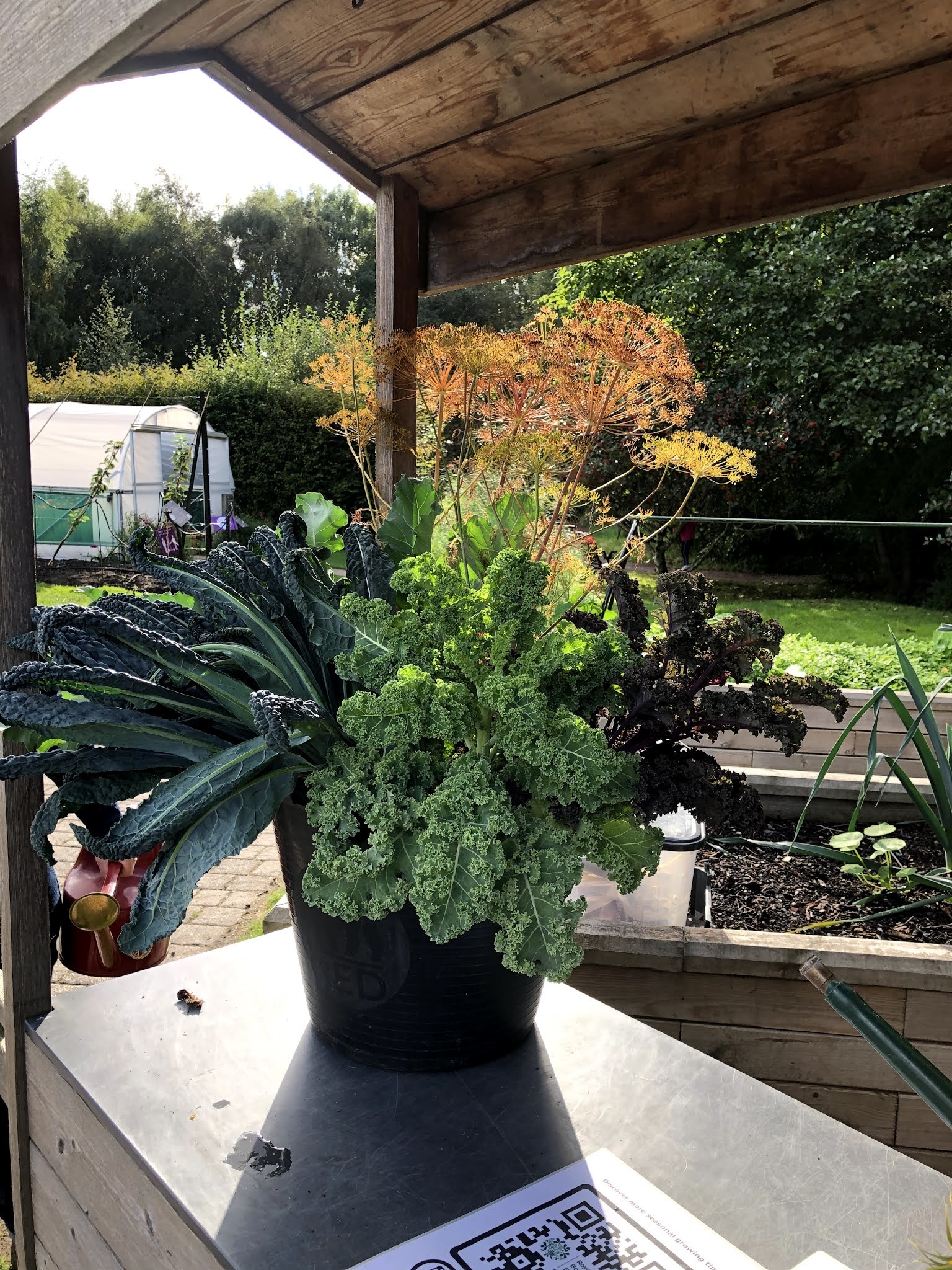
The "new" vegetable gardens, when I found them, were well worth seeing for their beautiful rows of different varieties of kale, squashes, courgettes, and beets, flanked by bug-repelling marigold. The "old vegetable gardens" still had the labels for various kinds of now-bolted lettuce and disappeared beans and peas and they were all planted over with bright autumn flowers--an excellent idea. 


There were happy pollinators--a new word for bees--all over the flowers, and I mistook part of the weather station  (founded in the 18th century) for a beehive. It turns out that when Edinburgh weather is measured and predicted, it is from the Botanics. Another interesting sight is, of course, the glass houses, begun in 1834. The enormous Temperate Palm House, built in 1858, exudes the confidence of Victorian Britain. It is really amazing. 


I had brought my phone, and the afternoon was punctuated with brief but important-to-me family communications from and to Canada. It's a good thing the day was so lovely, for otherwise I would have felt rather sad to be cut off from so much "back home." As it was, I was feeling very out of it by bedtime, and this morning I looked up flights and then the regulations. The regulations are still onerous for those in our situation, so we continue to wait. It's nice to see that Air Transat did not go under, though.  


Saturday, 18 September 2021

Apple Cider Day


It's the Fourth Annual Cider Squish here at St Benedict over the Apple Tree. This morning I picked a number of apples (and scraped my shin on a branch while clambering about), went to the beach for language exchange, and returned to pick more apples. This year I used a metal stick with a loop on one end, loaned by one of our neighbours. 

"I call it a fruit loop," he said. 

It was a lovely sunny day, so a good sprinkling of neighbours were outside gardening, tending their pigeons, and generally commenting on the apples and enjoying the sun. 

Despite the stick--which for the first time ever enabled me to get apples near the top (but not at the top) of the tree--I gathered only 14 kilograms of apples, which is to say about 130 apples. They produced 7 litres of juice, so now I know how much juice to expect per kilo. We may try for another 2 litres next weekend, collecting the remaining apples as they fall. On the other hand, we may not, as Benedict Ambrose looked very tired at the thought.

As usual, B.A. wore the green boiler suit he got from the Head Gardener at the Historical House some years ago. The green boiler suit is a sign that B.A. means to get right down to work, possibly in solidarity with the Workers. I feel that if General KoĹ›ciuszko were alive in Scotland today, he would put aside the lovely white coat of the peasant and don the green boiler suit. At any rate, when I got home from the beach, B.A. was in his boiler suit and had already sterilised the fermentation bin and screwed the apple press to a wooden pallet beside the veggie trug. 

B.A. cut up a bowl of apples while I was out getting more, but I managed to weigh them all anyway. We had a lot of trouble with our big food processor, which I mention because we checked this very blog to see if and how we fixed the problem last year. Sadly, I didn't go into that much detail. For the sake of next year, we have all the pieces, and we saw it had a 13 A fuse, and we simply don't know why it doesn't work. (Could it have been the fuse? We didn't try replacing that.) B.A. even took the food processor  downstairs to ask the neighbour, which shows how humble and sensible he is--actually asking another man for directions, as it were--but the neighbour was no longer in. So in the end we used the small food processor. I chopped, and B.A. ground. We filled a wash tub and two bowls with apple bits:


When we put the bits in the apple press, the juice came out eagerly, red-brown and fragrant. I hoped this was a sign we'd get more juice from fewer apples this year, but we did not. I expect that in the end we will have 14 half-litre bottles--unless of course I make 2 more litres of cider on the sly. 

What is more likely is that we will collect the fallen apples and make more crumble, pie, turnovers, strudel  and pancakes. The principal reason we have less juice this year is because we have been harvesting apples for a month. Last Sunday alone I picked 3 Kg for the strudel. This is what happens, I see, when cider-making gets delayed. However, we do not regret it, for we have enjoyed all the puddings. Learning how to make strudel was, as I probably mentioned, the fulfilment of a childhood dream. 

By the way, we did have one bottle left over from last year's harvest, and we drank it with friends after we finished pressing the apples from this year's. It was very appley, not too dry, quite satisfactory. 


 Notes to self:  1. We took a reading of 1.040. 2. I added 1.5 Campden tablets to the juice in the evening and mixed it in before putting the fermenting bin back in the bathroom cupboard. 3. Getting supper from the local Chinese takeaway is, according to B.A., one of our Cider Day traditions. 

Wednesday, 15 September 2021

Garden Dreaming

In its heyday, a very important pond.

I have been pencilling scale drawings of our garden on the graph paper at the back of my budget planner. The logic is that I will keep my budget planner for years, enabling me to settle a dispute in 2027 when we argue how much we spent on cider-making supplies in 2021.

It was amusing and instructive to go outside with a metal tape and measure all the necessary distances. For  one thing, the area of the garden--which was thrown in with the price of the flat--is much bigger than the area of the flat. For another, our downstairs neighbour opened her door to ask what I was doing and had to be satisfied with my boring and obvious answer. I could have said I was figuring out how much fence we need, but I only thought of that later. 

I now have two scale drawings: the garden as it is ("Garden 2021") and the garden as it could be ("Garden 2031"). Occasionally I get up from my desk, go to the door and look over the expanse of grass, tree and concrete and imagine Garden 2031. Then I adjust my vision, and Garden 2021 reappears, bringing with it the possibility of leaving it alone and thereby saving thousands of pounds. 

However, since we do have a garden (and so many people don't) and working in a garden is good for both one's physical and metal health, I think developing it would be better than not developing it. Besides, if I put a greenhouse, 3 raised vegetable beds and a raised pond on the lawn, there will be less grass for Benedict Ambrose to mow. Also, if we pull up the concrete tiles covering the last three-eighths towards the apple tree, we could hammer in a fox-proof fence and raise hens. 

There is also the environment to consider. The local fauna might not care so much about the vegetable beds (I hope), but I'm thinking of planting flowers that will attract butterflies, bees and (especially) ladybugs. I could pull up parts of the concrete slab paths and plant more berry bushes. Naturally my wildest dream is to plant a permaculture food forest--our prehistoric ancestors ate a lot of hazelnuts--but I don't have the heart to destroy the lawn to that extent. 

The first thing to do, of course, is fulfil our promise to our next-door-downstairs neighbour and put a proper fence between his rather Zen (complete with Buddha) garden and our riotous rosa rugosa. To do this, we will have to cut them right down to the ground again. If I could, I would grow espaliered fruit trees against this south-facing fence-to-be, but I don't think the roses would allow it, even if we did keep brutally cutting them back. (I know how to poison them, but I don't believe in poisoning plants.)

One thing of which I am relatively sure: the expanded vegetable gardens are not going to pay for themselves, and we're not sure the garden office (which we will enjoy designing) will either, should we decide to sell the flat. Naturally, we aren't going to do anything crazy until B.A. has found a full-time job in Edinburgh. If we suddenly had to move to Durham or Belfast, it would be inconvenient to have just built a garden room de luxe. However, we still have some time before B.A. has his professional diploma in his new field, so it is worth putting in the fence and buying the greenhouse and trying to grow tomatoes that remind us of Italy.