Saturday, 23 January 2021

She wrote something recently, but she wanted money ...

Dear readers! It is I, your old blogging pal, back from the trenches of the culture war, but not for long. 

This week I have been heavily engaged in what more than one Pole is calling "a battle with the Civilization of Death", by which they mean, unfortunately, the UK Court of Protection that effectively, in the words of a Polish archbishop, "sentenced [a man] to death by starvation." 

You can read all about it here. 

The case of the NHS vs RS was heard on December 15, and I wish to goodness I had known about it by then. As it was, I wrote my first article about it on December 23, and the story got picked up by wPolityce.pl, who ran with it. 

In short, a hard-working Polish man had a heart attack, sustained bad brain damage, and fell into a coma. Although he is by no means brain dead, his wife agreed with the hospital to cease life-sustaining treatment. As he could breathe on his own by December 15, that meant ceasing such basic care as clinically assisted nutrition and hydration until he was good and dead. So much for the corporal works of mercy. 

However, the man's birth family, including his mother, objected to his being starved and dehydrated to death, and his aged widowed mother went through two-thirds of her life savings to stop this. Eventually the devoutly Catholic family turned to a British  Evangelical Christian legal charity called Christian Legal Centre, the same people who fought for the life of Catholic Alfie Evans. 

The Christian Legal Centre has so far spent £70,000 on the "RS" case, and my workplace hit upon the notion of raising at least £50,000 for them. I feel very personally involved in the CLC's unexpected financial burden, and so I am asking everyone I can think of to donate even just £5 towards these legal fees. If everyone who reads my day job writing donates just £5, we will have the money in a brace of shakes. And I don't think I have been so anxious about a fundraising campaign in all my life. 

Anyway, that is all I have to say, really, except to pray that God's will be done in the RS case. 

Polish media are fighting among themselves about whether the Polish Government should annoy the British Government by insisting on their citizen's right to life; from what I've read, Polish Catholics are pretty well horrified that their fellow Polish Catholic is going the way of Alfie Evans. And Alfie, as you may recall, couldn't breathe for himself for very long. RS has been without food or more water than it takes to keep him sedated and (I hope) pain-free for over a week now. Also, Alfie was never able to speak for him, and RS was. One of the things he said was that he was against what the judges did to Alfie. And one of the horrible ironies in this case, is that the Court of Appeal judge who said that Alfie had "the right not to be alive" was one of the judges who held the same for RS, too.

Sunday, 3 January 2021

Many walks, much study, pierogi & cgm

Happy New Year, dear blog readers. I apologise for my long absence; the writing well had run dry. As it is, I have been on Christmas holidays since December 23 (although I wrote at least two articles during that time) and yet only now do I feel sufficiently enthusiastic to put fingers to the keys. 

What have I been doing? Well, Christmas baking and Christmas cooking: florentines, gingerbread cookies,  Chelsea bun, makowiec (poppy seed cake), Alaskan trifle, cheese-and-potato pierogi, mushroom-and-cabbage pierogi, clear red borscht with mushroom dumplings... Not bad for a woman who had Christmas dinner elsewhere, i.e. in the countryside with husband and friends. 

And I have been going for walks: a lovely long countryside walk in Fife, and then a tramp up and down Berwick Law (and I fell heavily on the ice three times on the way down and was then quite terrified), and yesterday a hike along the Firth of Forth (and B.A. fell heavily on an icy stone and had to limp to the bus stop). Today I walked around and around the icy Meadows by the University of Edinburgh in the rain, under an umbrella, chatting with a girlfriend who wears latex gloves under her woollen gloves, as her hands got cranky from too much hand sanitiser. 

Then I have been studying: weekly Italian classes over the phone, and making and memorising Polish flashcards, reviewing Polish grammar, and reading Polish articles clearly derived from my own articles. 

Polish Catholic journalists are quite clear about their sources, and it is interesting to see how many Polish articles end with the words "Zródło: LifeSiteNews." I am both happy and annoyed that most of the articles in Polish on a certain story of Polish interest are derived from my articles on the story. On the one hand, I am pleased to be so influential, but on the other, I wish the Polish journalists would find out something new for me to cite in return. 

In related news, I am getting rather better at making pierogi. I had relatively few in-pot explosions this year, and when I was running low, I just mixed up another bunch without fear and trembling. The secret to pierogi-making, besides not putting in too much or too little stuffing, is to make many often--or, at very least, make them every Christmas for years. The ultimate goal is to make pierogi dough so soft and thin that it all but melts in the mouth when you bite into the pierogi. If eaten boiled, it should taste of clouds. If you fry them afterwards in butter, though, it can just taste of ... well, summer holidays near Wrocław, winter birthday weekends in Kraków, and Christmas Eve. 

I have been trying out a new hobby: the Curly Girl Method. In short, I got tired of wearing my hair in two braids all the time, like a superannuated Greta Thunberg. For a week I wore it in rather untidy box braids, hoping to look more like a hippy than a culturally insensitive white pop star, and then I read a lot of agonised online questions from other white women with super-dry, super-curly, super-thick hair on some forum about socially acceptable hairstyles. Che incubo/jaki koszmar/quel cauchemar/what a nightmare! 

I decided to find out what my curl pattern actually would be if my hair wasn't as dry as horsehair sofa.  I hydrated the living daylights out of it, and then plopped it on top of my head in a long-sleeved T-shirt to air dry. The result was a mass of waves and ringlets no wider than a pencil and an itchy scalp. Within a week, the ends of the waves and curls had snarled together and my hair was drier than ever. So I repeated the operation, this time with more products, and I again had a mass of waves and ringlets that eventually snarled together before drying out. 

What the CGM & NHM call "Day 2".

This went on for a month or so, and then this morning--after an arduous hour in the shower involving only Maui Moisture Hair Care Shea Butter Hair Mask, Faith in Nature Dragon Fruit Conditioner, Cantu Coil Calm Detangler and Aussie 3 Miracle Oil--I drew a straight line down my scalp with my comb and put my damp (but tangle-free) hair in two braids. My hair still isn't dry yet, so I may undo it and attempt to coax it  into 18 ringlets. On the other hand, I am not Bernadette Peters, and I can just keep winding my braids around my head like Dorothy Day. 

Of the above, the second-cheapest, Faith in Nature Dragon Fruit Conditioner, is pretty useless for my hair (not enough "slip", as the Natural Hair Movement video stars say), and the cheapest, Cantu Coil Calm Detanger, is the best. I read and watch good things about other Cantu products, so if you have somehow stumbled upon my idiosyncratic blog by Googling "Curly Girl Method," I recommend trying them.  

I have learned from the Natural Hair Movement that box-braids, cornrows and various different kinds of hair arrangements are known as "protective styles" because they stop dry and fragile hair from snarling breaking. However, they are laden with cultural significance, and I dread being attacked on the bus by Guardian readers for appropriating the wrong one.  

Well, a few more months, and I will be able to wind my braids over my head so thoroughly, I will be able to braid the ends together and tuck them up, and that will be the superannuated Greta problem solved. 


Wednesday, 25 November 2020

Another Walk Around Edinburgh Part 1

Today was my Professional Development Day, so B.A and I went to discuss my work with our ghostly counsellor. We took our time getting there: in fact, we did quite a lot of the journey on foot. I took advantage of our bracing stroll (it was sunny but cold) to take photographs for people who cannot travel to Edinburgh and miss it. 

I took a goodly number of photos, and we walked through four or five distinct neighbourhoods, so they will not all fit in one post. 


1. This is the Surgeons' Hall Museums. I have never been in, but I hear they are gory. They are on Nicholson Street, near my favourite cafe.

2. This is the Festival Theatre. It is locked up because of the coronavirus panic. As you can see, it has resorted to begging for money. Bizarrely, although British society is hooked on entertainment, out performing arts are in serious, serious trouble.


3. Speaking of the performing arts, here is the Varsity Music Shop.  It is Edinburgh's "longest running Musical Instrument Store." I don't know if it has spent all its 50 years at this location, but it has certainly been there since I've been here. 

4. Jordan Valley is a Middle Eastern grocery with a very large range of teas. If you want delicious exotic foodstuffs, this is a good place to go. 

The photo slants because the road slants. One of the strange things about this particular street of many names is that two parts of it are literally bridges, but you can't tell until you come to the balustrades and look down. 

Edinburgh is built on seven hills. 

5. South College Street looking across the beginning of the South Bridge to Drummond Street. 
6. Here is an ugly bit of Edinburgh University on Potterrow. Potter's Field is more like it. 

7. Here is a much nicer building in Edinburgh University. We are now on Teviot Place. 
8. This is the Middle Meadow Walk through Edinburgh University to the Meadows, and it is very nice indeed. 
9. Sadly we didn't have time to go for a walk towards the Meadows. Instead we turned onto Forrest Road. Here is a post office rather important in my life.  The big red bin is a double post box.

10. This is Sandy Bell's, a very good pub. It is one of the few Edinburgh pubs I've had a half-pint in. It's closed for the duration of the coronavirus panic. No wonder: all pubs, bars and restaurants in Scotland have had their liquor licenses removed. All Sandy Bell's served besides beer, wine and liquor was the occasional pie.

If you want a drink in Scotland, you must get it from the supermarket--or make it yourself. 

There must be a lot of solitary drinking going on behind closed doors in Scotland. But in happier times, folk bands would meet in Sandy Bell's to play as others drank their pints. I think random people with random folk instruments would just come together and play, too. 


11. Here is a double-decker bus. Edinburgh abounds in double-decker buses. 

12. Forrest Road turns onto the George IV Bridge, and then Candlemaker Row slopes down from the Bridge to the left. The George IV Bridge swoops over the Canongate below towards Bank Street. An engineer might understand what the original hills and valleys must have looked like once upon a time, but I can't get my mind around it. 


13. Here is the monument to Greyfriars Bobby, a semi-legendary Skye Terrier who allegedly sat on his master's grave for years and years in the nearby Greyfriars Kirkyard. 

Bobby looks rather shiner in this photo that he does in real life. Usually his whole head is golden from tourists rubbing him for good luck. Now just his nose is. 

The summer of 2020 was probably the first since World War II when crowds of tourists weren't constantly having their photos taken with ol' Bobby.

14. We were surprised to see that the Elephant House was closed.  B.A. said, however, that lately it has been entirely about Harry Potter. Elephant House bills itself as the Birthplace of H.P., Joanna R. having written some of the first book there to save on heating. 

When B.A. went there regularly, it was still largely committed to elephants, not touristy, and a nice place for him to drink pots of leaf tea. The National Library used not to have a caf, so he would sit there on his break, drinking tea, eating tiffin and looking at the amazing views from the back windows. 

He once wrote a haiku there, too: 

Pale golden lapsang
In my cup; on the Castle
Pale golden sunlight. 


15. This is to remind us that George IV Bridge is a bridge. Vittoria, on the right, is an old-fashioned Edinburgh Italian restaurant. B.A. and I once gave a Chair of Moral Philosophy Professor of Analytic Philosophy and Logic supper there. He was a very charming and entertaining guest, as you might expect the current successor of Adam Smith to be.  (Correction thanks to B.A.)

16. This delightful Victorian architectural mess is the Central Library. I adore it. I have spent long hours browsing its extensive language section and, across the floor of the main room, the Agatha Christies. I have also taken out several volumes on making cider, raising chickens and any number of other interesting things.

The Central Library has several floors, including one dedicated to Scottish Stuff and one to Art. 

17. Attached to the Central Library is a building housing the Central Children's Library. I sneak in there to take out Rosemary Sutcliffe books. 


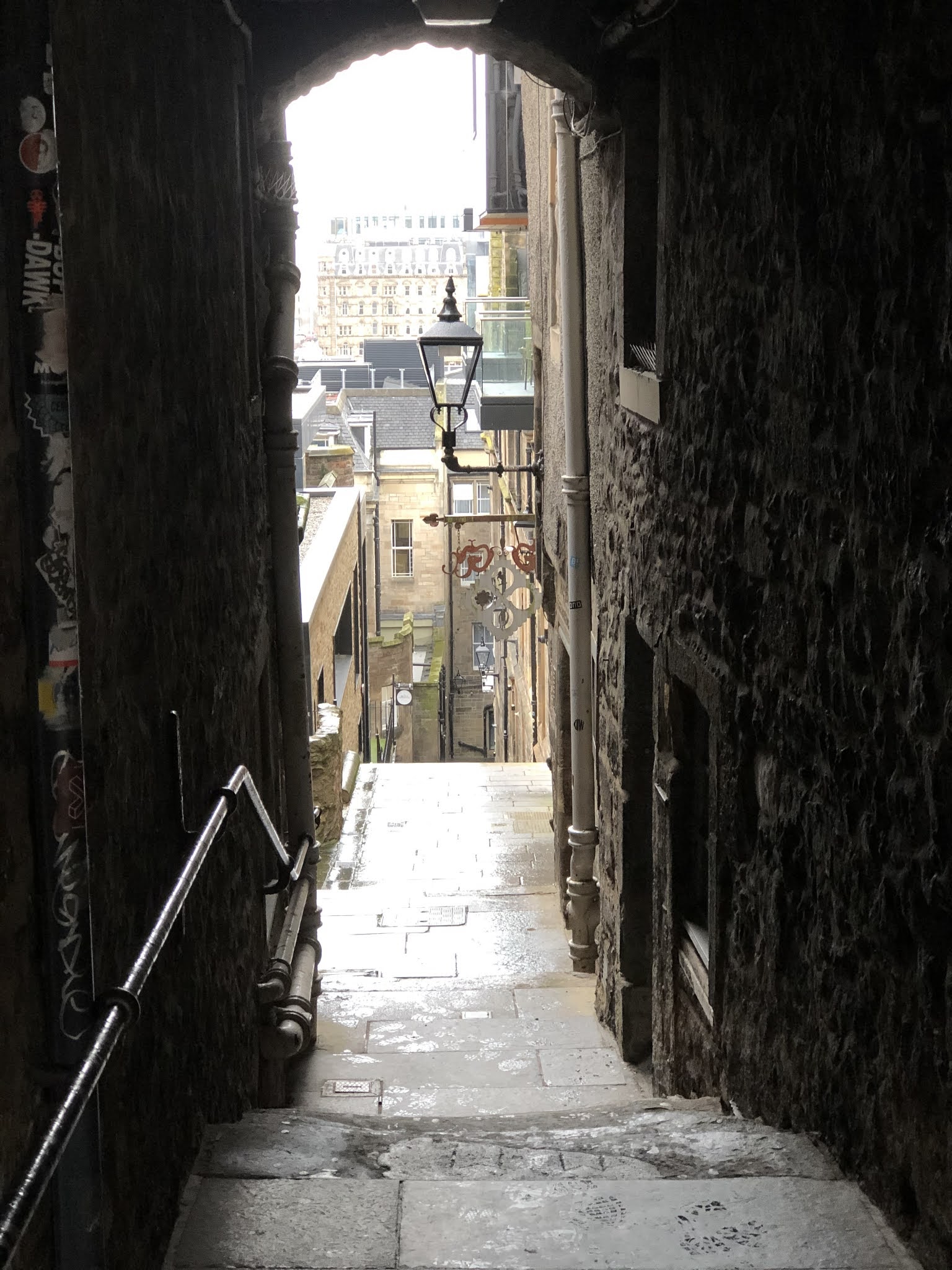
18. And here is a shot from the other side of the street of the Cowgate below. But now we are about to cross the street and toddle down the Bow to look at Walker Slater's, and you have seen this already recently. 

Thus I will end this entry, and put in some photos of the next stage of our walk tomorrow. 

Tuesday, 24 November 2020

The Transfiguration of the Commonplace

 The title of today's post is taken from the writings of Edinburgh native Muriel Spark. My guess is that it denotes an ordinary thing or well-known person suddenly flaming up into something or someone extraordinary, revealing something to which familiarity has either blinded us or could not perceive. 

It reminds me of my Sunday walk through Edinburgh, when I took photographs, like a tourist although--to be honest--the ordinary shops and sights I captured were not revelatory. My intent was to make a record of them in case they disappear under the waters of the lockdown. I also thought it would be nice for my mother to see them, as she is trapped on the other side of the ocean. 

On Sunday I had a pub lunch with a friend and then coffee and pastries with another friend. 

The pub was on Dalkieth Road, and after lunch I walked down Salisbury Road, bound for distant Dalry Road. 

I looked back at the Commonwealth Pool and Arthur's Seat behind it. 

The red sandstone tenements are typical of Edinburgh. 

As I made my way down Newington Road, which would turn into South Clerk Street, Clerk Street and then Nicholson Street, I noticed this homely and colloquial advice. I thought again about neutron bombs and what Edinburgh would look like without any actual Scots in it. This, for once, was visual evidence that Scots--and not just Poles, English, Americans, Canadians, Chinese, Arabs and a host of other nationalities--live in Edinburgh. 
More homely advice in the vernacular. 


Verdo is a Turkish restaurant. The food is delicious. B.A. and I once had a belly-busting feast there before rushing off, painfully, to a concert at The Queen's Hall. 

My mother will probably not recognise these shops, for our border is usually East Preston Street, and thus we rarely walk up or down the part of the street called Newington Road. 

Brew Store is one of the few goods shops we frequent. It is where we buy our cider-making equipment. One day during the lockdown, I suddenly popped in and bought 12 glass cider bottles with ceramic tops. They came in a big box, which I lugged to the bus stop.

I couldn't browse, as I was allowed only through the doorway, where I found a counter, as if in a post office, and a young man who took my order and went away to fill it. 

This is a building with a Sainsbury's supermarket. It is small and good mostly for convenience foods and disposable barbecue kits for summer lunches on the nearby Meadows.  


This is one of the few places in Edinburgh that has very good croissants. May it survive the coronavirus panic.

Someone on Clerk Street is asserting their love for Slovenia. 

Like the nearby Edinburgh University, South Clerk and Clerk Streets are rather cosmopolitan. 

USA Nailz is run by, I believe, Vietnamese people who speak to each other in Vietnamese, just like in urban nail shops in the USA and in Canada, too. 

Getting your nails done here is less expensive and less time-consuming than getting your nails done in a more typically Scottish beauty shop. There is also no expectation of conversation. I find talking to Scottish nail technicians an absolute minefield of potential misunderstandings. 

When my conversational Polish was absolutely at its best, I had a very long conversation with a manicurist in the New Town. Afterwards I was mentally exhausted but with the comfortable sense that neither of us had offended the other. 

Edinburgh Fabrics is run by a South Asian family. It is very big and stuffed to the gills with interesting fabrics, cutting tables, zippers and etceteras. The windows are always attractive, and I have been here with my mother a few times. 

My mother, unlike me, is clever with her hands. She can sew, quilt, knit, embroider and crochet. Therefore, Edinburgh's knitting and fabric shops, which have hitherto managed to hang on in greater numbers than ones in Toronto, have a family interest.


This splendid building contains a Starbucks. Personally, I loathe Starbucks, even this one, but in the past it has been a Saturday afternoon refuge for B.A. I have met him there after doing various errands of my own, drinking a caramel macchiato and catching up with back issues of the London Review of Books. 

Honestly, why take photos of supermarkets? They aren't going anywhere. This one, though, is useful for it has a wide selection and a goodly Polish section.

Clerk Street will soon turn into the South Bridge. 
This is Blackwell's Bookshop on the South Bridge. It is a positive heaven of new books, including language textbooks. It hosts readings, and so far I have been to a friend's reading there and to my own. It is the one place in Edinburgh that has ever sold my books. It is the one place where I ever felt deeply and joyously glad there was such a thing as the Edinburgh Festival. 
Le Bon David may have been cancelled at Edinburgh University, but his statue still stands, undamaged, on the Royal Mile. 

Normally I would not pay the dirty-French-novel-buying atheist librarian any attention, but I objected to his egregious cancellation. 

Actually, it's not Hume I feel annoyed for but the modern-day Scots. There is a plot afoot to make the Scots feel as ashamed of themselves, their ancestors and their history as too many Englishmen now are. Awa' and bile yer heid, is what I would say to that, had I the proper accent. Doon yer tea. Eat yer bread.

A hundred years ago, Edinburgh's poorest literally starved to death, and Trainspotting, I never tire of saying, is a documentary. And there's still plenty of Scots misery to be found in the parts of Edinburgh tourists and foreign academics never see.   

The  Royal Mile and poor old Gladstone's Land, its shop and offices boarded up. One of the larger victims of the coronavirus panic is the National Trust for Scotland. 

Gladstone's land was build in the 1620s, so that's a 500 year old apartment building you're looking at there. Only a few floors are museum-worthy, though. 

We once spent a few cramped months in a holiday flat there. Lovely views, very romantic, close to excellent croissants and good libraries, but otherwise very impractical.

That's a castle at the end of the road. It's been a military base for quite awhile now, but tourists like it. Chippy medical students who spit on the graves of Scottish soldiers, not as much. 

I've never shopped for a Freemason in my life, but if you want to find some, here they are. 


The military base. Its shops are not as personally exciting to me as the shops of the bigger of the two U.S. naval bases in Naples, but that's another photo essay. 

I once arranged and chaperoned a blind date here. What was I thinking? Oh yes, I was attempting to make a birthday memorable for a young friend. I wore all blue and had a terrible shock in the loo when I looked in the mirror. I had forgotten I was about 20 years older than my guests. 

Afterwards we went to a concert. This is in Edinburgh's "theatre district" by the way. 

Just to the left of the traffic lights is The Filmhouse. It is our favourite cinema, for it shows films we can brag about watching afterwards. To be serious, though, it is very cool to see Great Films in an actual theatre for a change. 

Amusing story: because I had only ever seen great classic Polish cinema, I thought all Polish films were like them. I was therefore terribly shocked and disappointed when I saw the then-latest Polish release down the street at the Odeon. 

That said, I saw a Polish vampire-mermaid porno at The Filmhouse. I didn't mean to do so, but that's what it was. The Polish woman sitting in front of me left in a noisy huff at the breastfeeding scene, and no wonder.

I was on my way to Dalry Road, by the way, and I took a shortcut I remembered from a cold Christmas Eve. I walked along an ugly modern development beginning near The Filmhouse , crossed a pedestrian bridge, and arrived in this beautiful square of townhouses and embassies. 

My new favourite house. To be purchased after we win tomorrow's lottery. 

But now this post is too long, so I will have to create a second one later. We don't have much further to go, though, to get to Dalry. 


Sunday, 22 November 2020

Mental Food

My pet conspiracy theory, which is probably less a theory than a fact, is that popular entertainment has been used to influence and re-educate the public since the Hayes code ended, if not before. It is definitely a fact that social media are designed to be addictive. It is also a fact that social media are free because they collect  information about us to sell to advertisers. We are--or become--what we watch or read or sing. The advertisers know that. The social media giants know that, too. 

I am not addicted to my smartphone, but when I am at home and awake, I am online most of the time. This can be good--for what is the internet but the world's greatest encyclopaedia?--but I fear that it is also bad. I read, but I don't necessarily retain. Studies prove you learn information much better from reading print and writing by hand that from reading and typing on a computer, and although I wrote 10 or 11 news stories last week, I couldn't list them off for you. 

Another bad thing is the sitting factor. I seem to recall, once upon a time, reading and writing in a university library, having a stretch, going for a little browse in the stacks upstairs or down, having drink of water at the fountain, and then sitting back down. (I also recall the University of Toronto's ample gym facilities, of which I am clearly in sore need.) Now I sit for hours on end without noticing stiff muscles or thirst. 

But I am also concerned by the content that streams into my head via the internet because it is usually sad or angry or contentious. It occurs to me that this might be why I am so often sad, angry or contentious myself. Was I like this before 2005? 2005 was the year I got my very own internet connection, and so I have been plugged in for 15 years. Lawks!  

I woke up this morning pondering my internet usage and told myself that my mind has most definitely dimmed since the mornings I arose early to write precises of questions in the Summa Theologiae. But then a kinder voice spoke up in my defence, asserting that I now speak and read Italian and Polish. So that is something. It's worth noting, however, that this is largely thanks to real-world interactions and printed material, especially flashcards. Since March I have spoken to my Italian tutor, not via Zoom, but over the phone. 

The best, most cheerful interaction I have had in Twitter for months, by the way, was with a young Englishman who was delighted to discover the Polish word zretweetować. One of the charming difficulties of Polish is that the Poles make up new words all the time. They either play with the prefixes or the suffixes, or they instinctually know which ones are grammatically logical and correct for their new words. Anyway, I was charmed to have seen this stranger's retweeted tweet, and I wrote back to ask if the present tense is conjugated retweetuję, retweetujesz --leaving off that 'z', you see, for the present and imperfect tenses.

He responded to say, yes, he believed zretweetować was the perfect form of the verb, and I gave him a "like." And although, yes, language and linguistics departments have also been captured by the cultural Marxists, what fun it would be to think about Polish prefixes all day and to correctly guess at other Polish neologisms.  

Or would it? Here it is Sunday, and instead of writing up another batch of flashcards, here am I on the internet, distracted only briefly by the appearance on my smartphone of a short film of Córeczka dancing in her crib. However, writing a blog is like writing a letter, and writing letters is always active, not passive.  

For the point that I have been trying wordily to make is that there is a great danger we are most of us passively consuming ideas much more than we are actively thinking about ideas, actively accepting or rejecting them, and then generating new ones. We become what we read or watch online, which is probably why so many of my conservative friends are Covid skeptics (to a varying extent) whereas so many of my centrist and left-wing friends are Covid believers. 

Naturally this in itself is not a new idea. Neil Postman published Amusing Ourselves to Death in 1985. He believed even then society was becoming controlled by its addiction to entertainment. As he died in 2003, I can only imagine what he would say now. 

Saturday, 21 November 2020

In This City


Was it quarantine? Edinburgh seems to have recovered some of its exotic glamour for me.  Having lived here for over ten years, I can only dimly remember how mysterious and romantic the city seemed when I first arrived. However, it didn't occur to me even then that these old buildings will inevitably crumble one day, or that even a hill fort inhabited for two millennia will one day be empty. Thanks to the coronavirus panic, such thoughts have now intruded. 

One thing for certain: everything changes. In Rome I thought it might be a fun project to photograph the windows of the Dolce & Gabbana shop in the Spanish Steps every day. I neglected to photograph a dress I particularly liked (it had the same petit-point roses as a cushion my mother made), and a week later it was gone from the window: the window dressing had changed. And no, it never occurred to me to enter the shop to look for it.  I cannot even, as the kids say. 

So yesterday after I had another post-apocalyptic breakfast in my favourite cafe and--luxury beyond belief--kept my 15 minute appointment at Central Library, I began to take a few photographs. I was due home to begin writing the Worst News of the Day, but I thought Benedict Ambrose would enjoy a pain au chocolat from La Balantine in The Bow. The Bow is truly one of the splendid sights of the Old Town, even (or especially) when it is all but empty at 9:30 AM. 

1. This is The Bow, otherwise known as Victoria Street. It is on a hill sloping down to the Grassmarket, which is a relatively flat central place.  It is lined with colourful shops and restaurants that tempt residents quite as much as tourists, if I am anything to go by. 


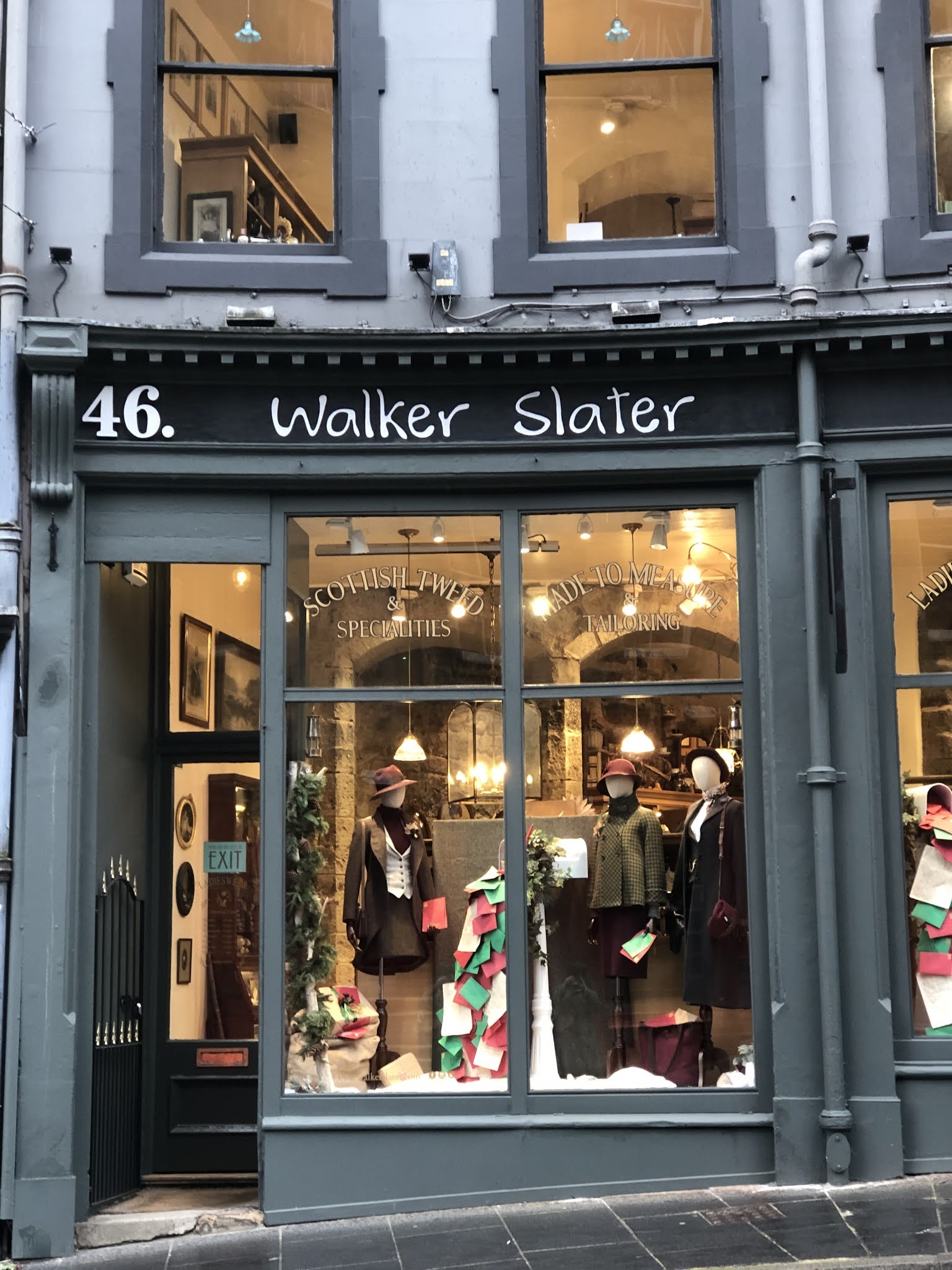
2. This is the most successfully tempting shop in The Bow, as far as I am concerned, for this is where I go to buy Benedict Ambrose presents. Usually the gifts are small: a birthday tie, or the tweed messenger bag I began to borrow. However, this year we had a most delightful binge: we bought him a three piece suit. I had longed to do that for ten years. 

B.A. once bought me a little tweed owl from Walker Slater. It was to cheer me up after the Deluge forced us from our home in the Historical House. He wouldn't tell me how much it cost, and I am still blissfully ignorant of that today.

3. After staring in the windows of Walker Slater for a few years, I heard that it was shortly to open a ladies' boutique. I was tremendously excited when it opened and I could survey its own windows. When I got inside, however, amongst all the lovely blue, green, grey, brown and russet tweed and wool, I discovered that it was all very expensive. Could I justify a binge on my freelancer's salary? No. Alas, I could not. 

Later a temporary outlet store opened across the road, and to my immense satisfaction, I was able to buy a W.S. brown tweed skirt for an astonishing £20. 

Incidentally, all up and down the east coast of Scotland, this would be considered pardonable bragging. I have heard it whispered that in Glasgow people brag about how MUCH they spend, not how little, but then Edinburghers famously speak ill of Weegies, I mean Glaswegians. Surely they do not stoop so low.

4. The ladies' boutique in half its windowed glory. Clearly it is  highly virtuous not to spend thousands of pounds here on myself but to rejoice in my own brown tweed skirt that I got for £20.

I almost always work from home, so I really cannot justify a binge. On the other hand, the done thing among the gentlemen I know who have binged at W.S. is to wear their tweedy finery to Mass.  

Hmm.

5. Here is La Balantine. Like the purveyors of tweedery, it slopes dramatically. The windows are full of colourful pastries that shine like jewels. When you step (carefully) down into the shop, the floor of the small dining room is flat. Yesterday morning it was also empty of customers. 

"Bonjour!" said the young Chinese lady who came in from the kitchen.  Whoever is serving that day, French or not, greets customers with "Bonjour."

"Bonjour," I replied. "Je voudrais un pain au chocolat, s'il vous plait."

My accent was undoubtedly atrocious, but the waitress picked up on the nub of the thing. 

£1.85 is a lot for a pain au chocolat, but the ones from La B. are worth it.

6. I took this on my way back up the hill towards my bus stop. I have not dined in Le Maison Bleu, but I have purchased many a delicious sandwich at Oink. 

Once I went straight to Oink from the airport. If I remember correctly, I was coming back from Canada and was as hungry as a bear. 

All of a sudden I remember that I have not had breakfast yet. A moist pork sandwich with apple sauce and crackling would go down very well right now. Sadly there is no Oink within walking distance of home. 

7. And here's more of The Bow. It was a little uncanny how deserted it was, save for the vans, builders and me. The great Christmas snowflakes only underscored the emptiness. 

Edinburgh is really such a beautiful city. And this is only part of one street in the Old Town. I am alarmed to think that I might in future be threatened with an actual fine walking down The Bow. On the one hand, that is outrageous. But on the other it makes being on The Bow even more special.