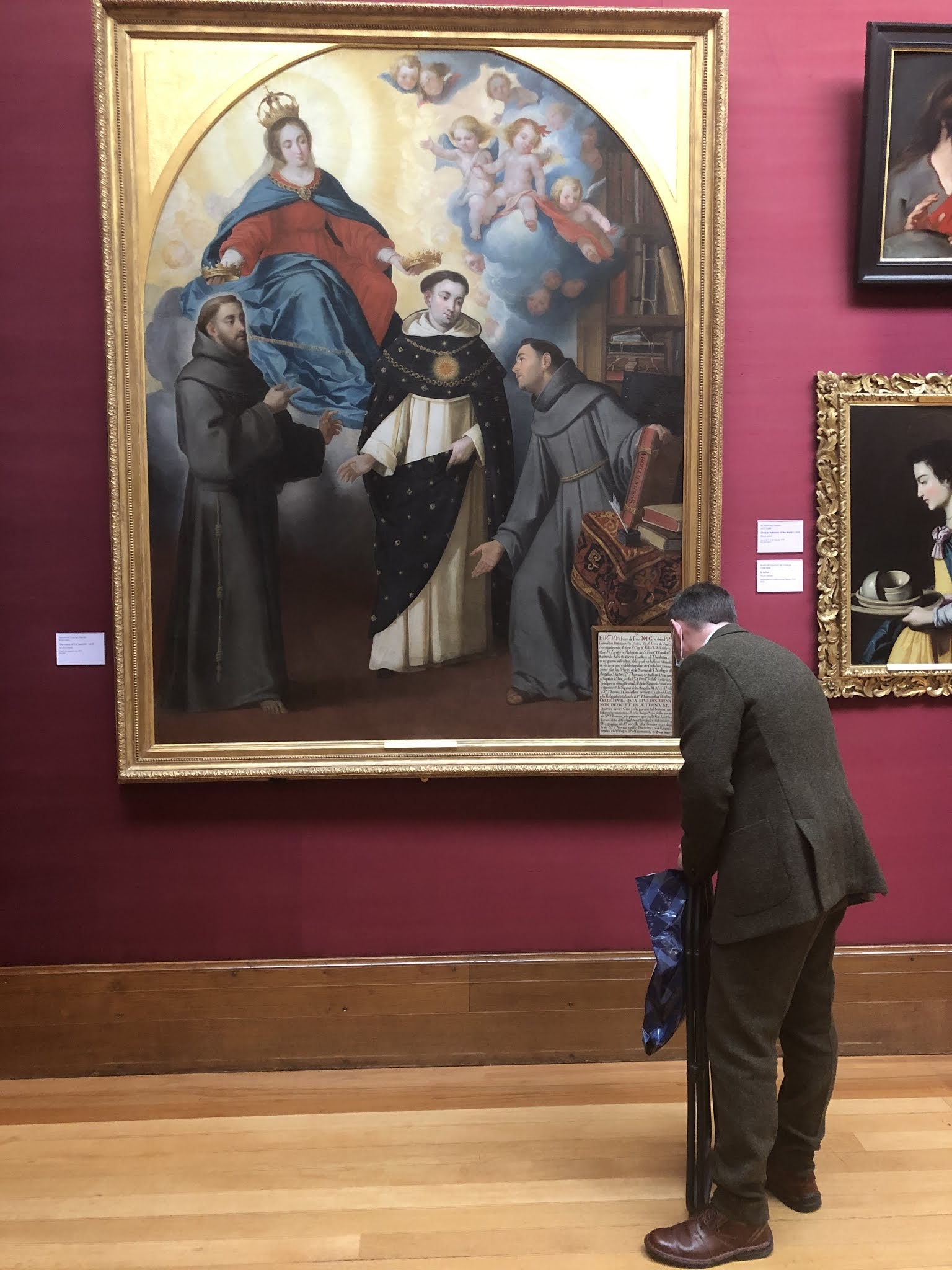
Wednesday, 30 September 2020

The Importance of a Good Story

I did not watch last night's Trump versus Biden debate. It's a whole different time zone over here. Instead I slept and had a nightmare in which I had a real, public meltdown about not having children. This will chill B.A.'s blood, but I think in the dream I was shouting at two of his female work colleagues.

"It's as if you could never go to university," I yelled at one. 

"And it's as if you could never, ever go on holiday," I screamed at the other. 

In real life both these women are childless, by the way, and apparently tranquil about it. 

Anyway, that's the last time I look at the "pets available for rehoming" websites just before bed. 

Sometimes I get chastised for promoting happy singleness because it seems anti-marriage to my critic. It can be difficult for people to understand that being a happy Single is key to attracting a potential spouse. It's a paradox. The happier you are as a Single, the more likely you are to get married--or to find the right religious order, if that is the life to which you are called. People like happy people. 

Of course, you can't marry just anybody, which, by the way, my critics occasionally contest. For years I thought that the reason to promote the chaste Single state as an attractive way of life was to help women not marry the wrong man (e.g. the one whose attraction mainly lies in being the man most interested in you the week before your 25th birthday). Then I realised that another reason is to help women not marry when they are still the wrong woman. 

Because there are serious implications to not marrying until you are in your late thirties, it would be a gift to Catholic women to sort out how to become the right woman (and find the the right man) in one's twenties. Naturally, a lot of women have this sorted in their twenties. The rest of us might be able to learn from them. 

But to skip ahead to what makes a marriage last, I think a good origin story is very important. If the way you and your spouse met, or how you got married, is a heartwarming story, that story can get you through the rough times. "Origin story" is, I believe, an expression common to comic book fans. Historians might call it a "founding myth." 

A myth is not necessarily fictional but it always conveys meanings and values. And I think this is why it is important for children to learn and love the foundational myths of their country. I'm not American, but I have enjoyed and admired the stories about the Pilgrims' First Thanksgiving, George Washington and the cherry tree, Betsy Ross and her flag, Johnny Appleseed, Paul Bunyan and the Blue Ox, and John Henry Born with a Hammer in his Hand. I am also edified by stories of the Civil War, in which thousands (including my own relations) died to end slavery in America, and the Civil Rights Movement of the 1960s.

I think people spit on those stories at their psychological and civil peril. 

In case you are feeling sad about my nightmare and are worried that this sort of thing might happen to you, you should know that this is something which, in my experience, comes and goes. Whereas "what the heart doesn't know, it doesn't sigh for" doesn't apply, it is not at all like having lost a real, come-into-existence child. I will probably never know what that is like, which is a mercy.

Tuesday, 29 September 2020

Joy of Childhood Things

We are home from Cambridge, having had a splendid time. 

On Sunday B.A. and I went to the TLM at Blackfriars, walked down as far as St Mary and the English Martyrs, and then met our Cambridge Uni pal for a Sunday roast at the Architect. After that we ambled down to the river,  agreed to take a river tour and were punted down and up the river by a genial guide with a good line of patter for 45 minutes.  

We saw many beautiful buildings and bridges and heard a number of interesting stories, some of which might even be true. 

Then we all took a long walk towards the railway station and, after some delay and looking at maps, found the place where my parents, my brother Nulli and I all lived when I was 3 and 4. To my delight, the woods looked the same, although the field (now screened with hedges) seemed a lot smaller. The raised "duckpond" has been drained, which is sad, but at least it is still there. The next time I visit, I will remember to crouch down and to look at everything from a four-year-old's point of view. 

Our house-complex (Grade II listed) was in a pretty neighbourhood, and B.A. and our friend enjoyed looking at the older houses as we made our way back to Hill Street. (I was on Cloud 9.) 

St. Mary's was open, so we all went in. I thought I recognised the pews, but I hadn't remembered how beautiful the church itself was. Naturally when I was four, my parents didn't think it was necessary to tell me of the lives and sufferings of St. Thomas More and Bishop St. John Fisher, depicted in stained glass. In some ways, St. Mary's is a monument to 19th century English Catholic triumphalism, but it has a Polish Mass on Sundays, which sweetens that. 

The challenge of the weekend was staying warm. Thanks to the Covid lockdown, our friend couldn't invite us into college rooms, and our AirBnB was tiny, so our days consisted of walking around between one reservation to the next. To kill time and rest our feet on the way to supper at the Mitre, we all ducked into one of the more Evangelical Anglican churches shortly after a service had ended. Rather soon we were approached by an Evangelical couple who welcomed us to Cambridge and asked who we were, etc. They asked my friend if she had come to Cambridge for a new job, and I was unpleasantly reminded of how, when I began a doctoral program, 15 years ago, people would assume I was too old to be a student.  

Life tip: when meeting someone older than you at a university or in a university town, never assume he or she is not a student just because they are over 30. It's intensely aggravating. Thank you. 

Eventually we were chased out of the church, which probably would not have happened pre-Covid, so no hard feelings, and we turned up early at the Mitre, which let us in. One or the other of us did all the frightening police-state routine with a smartphone. In short, if you want entry in a pub or restaurant in Cambridge (and presumably elsewhere in England), you must register yourself there with your smartphone. This, alarmingly, is called "Track and Trace." You are encouraged to order by smartphone, too, although at the Mitre we didn't. Instead we ordered pies and a trio of puddings from the waiter. The trio of puddings, which were classic British ones like bread pudding and jam sponge, were simply heavenly. 

Then it was only 8 PM or so, but we said good-bye as we were all terribly sleepy from a day out of doors and pub grub. 

On Monday, I studied Italian for 45 minutes and then wrote an article for work. B.A. brought me a pain au chocolat from the Castle St. Fitzbillies, which was very kind of him. Then, at lunchtime, I departed the AirBnB with my computer and the luggage, and met B.A. and our friend in the same Fitzbillies for a good-bye lunch. Then we all walked down to the railway station (which took exactly 32 minutes), and B.A. and I got on the 13:27 to London. We alighted at Hitchin, and took the 14:19 to Peterborough, whence we caught the train to Edinburgh. (The ladies' loo in Peterborough gave me a very bad impression of Peterborough.) 

During this complicated train journey, I managed to write another article, so I didn't feel guilty about travelling on a work day. The thing is, there was no return journey on Sunday. Meanwhile, my heart gave a bounce when I saw Berwick Law, for it meant we were back in lovely Scotland. 

My overall impressions are that Cambridge is a lovely town and students there are greatly to be envied. Covid has reduced much, but not all, foreign tourism, and most tourists are from other parts of Britain.  The "track and trace" system is shocking, annoying, and even frightening. If you or a companion does not have a mobile phone, you will not be permitted entry into pubs and some restaurants. 

The New Blogger is pretty terrible, so I have given up inserting photos and will just put them below.


Saturday, 26 September 2020

Joy of a Sunbeam

We are in Cambridge which, as I expected, is a little cold and damp. When the sun came out, I felt a thrill of joy. B.A and I were with our friend, who is a student here, outside a cafe on the new (1989) Quayside by the river,  and a sunbeam lit up the wall of the Las Iguanas restaurant across from us. 

So that is my moment of joy for the day, standing out amongst the general contentment from eating brunch,  visiting a college, going to a super bookshop, wandering through the Fitzwilliam Museum, having tea and cake on the Quayside, and later having a splendiferous Indian super near Jesus Green.  


Friday, 25 September 2020

The Toddler's Mite

What is the first memory of receiving enormous generosity? 

Mine is from the mid-1970s when my family lived near Cambridge University. My father was on sabbatical and my brother Nulli and I, the only siblings yet born, were enrolled in a nursery school.

The nursery school had a playground with a number of activities, I imagine, but the only toy I remember was the scooter. 

I very badly wanted to play with the scooter, the one day I remember, and I waited throughout recess for the bigger children to let me have a turn. Sadly, they did not. They did not relinquish the thing until recess was over and we were all called inside. 

That was my chance! Ignoring the call, I got on the scooter and scooted a bit. 

The next part is a blank, but I remember that I was punished. The school regularly gave us milk and cookies for our snack, but that day I was not allowed cookies, and possibly not the milk either. 

I'm fuzzy on that part, but not what happened next. My brother, who was only 2 or possibly 3, perceived that I did not have any cookies (or, possibly, milk) and immediately shared his with me.  

That was over 40 years ago, and the reason I thought of this this morning is probably because Benedict Ambrose and I are going to Cambridge this afternoon the 4 PM train to Peterborough. (I will be working on the train, never fear.) 

It's quite a lovely story: I hadn't before noticed the contrast between being oppressed, as it were, by the stronger only to be comforted by the (then) weaker. 

Wednesday, 23 September 2020

The Satisfaction of Cider

We just bottled our cider . We are drinking the 100 mL or so we measured with the alcohol thermometer, and it is very pleasant so far: appley and sweet, if not at all fizzy. That will come later. 

We filled all 12 of the new glass bottles I bought this year, and one brown glass bottle and six plastic bottles. The next step is to store them somewhere cool and wait for Christmas. 

In other news, I spent from 4 PM until 6 PM in the dentist's chair, and so I am very tired. One more round of dentistry to go this month. What a thing it is to have human teeth. 

I was told not to eat anything hard, like nuts, or anything sticky. Frankly, I was not in the mood to eat anything when she said that. During one particularly horrible minute, I was glad I hadn't eaten all day. However, shortly after I tottered outside and to the bus stop, I thought hard about soft and squishy comfort food. I was definitely in need of comfort. 

The upshot was that I stopped in at the supermarket on the way home for milk and chocolate and cooked a chocolate pudding as soon as I got home. It is now cooling in little glass ramekins in the fridge.  I shall cut up my supper into little tiny pieces, and then I shall have the Comfort of Pudding.

Tuesday, 22 September 2020

The Joy of Recollection

Today I read the CDF's new letter "Samaritanus Bonus: On the care of person in critical and terminal phases of life." You should read it. It is good. It's literally life-affirming. 

I was reading it very closely to see if there was anything new. New can be good, but it is often bad. I was very much hoping I would not find anything bad, for I would have to ignore all the good and bring everyone's attention to the bad, for such is the nature of my work.  

But the loveliest part of Samaritanus Bonus was the emphasis on accompanying the very ill, visiting them in their loneliness, and being compassionate with their suffering, and giving them hope of a better life beyond this one. There was a wonderful meditation on the Crucified Christ, too. And as I read about all this accompaniment, I remembered going to see Benedict Ambrose every day when he was sick, and what he was like when he was sick, and how I called in as many friends and family I thought he could bear the night before his make-or-break operation. B.A. was then too addled to think much about hope, but I was full of hope. 

Then I went into the sitting-room where he was reading and kissed the top of his head because I was so happy he didn't die after all. 

I went back to reading Samaritanus Bonus, and to my immense relief, on page 19 the CDF explained that priests can't give the Last Sacrament to people who are planning to be euthanised. They can't even be around when it happens. If I decide (God forbid)  to get myself bumped off by a medical professional, a priest will not be allowed to sit there and hold my hand while I am bumped.

The CDF had emphasised the love, companionship and care for the sick and dying for eighteen pages, illustrating why euthanasia of any kind was no substitute for that and was, in fact,  an a serious sin. That is the context, by the way, in which the guidance to pastors is given. And I was very glad that the CDF didn't cave and allow the the Last Sacrament into a kind of superstitious mumbo-jumbo or toss all the beautiful things it had said out the window in the cause of "being nice." The CDF meant what it said, the Church means what it has always means, and our lives do not belong to us, but to God. 

The meditation on the Crucified Christ should be enough to convince His followers that we shouldn't get a pass on suffering, or take the easy way out, when we die. 

I wrote a sad story some time ago now about a man who went to see his priest about his funeral shortly before his assisted suicide. A visiting priest had already given him the Sacrament of the Sick, not knowing (apparently) what he had in mind although half the parish did. The pastor tried to convince the man not to do it, but the man was adamant. He had a big party and the church choir came and it was all very Petronius' Banquet in Quo Vadis except with hugs and hymns. Then the man was pumped full of drugs, lost consciousness and died.  

What struck me about this story, when I was reading Samaritanus bonus, was the party. What if we had more parties for the very ill? I had a lovely, lovely friend who came home from the hospital to die naturally of her horrible cancer, and for the last days of her life, she kept a kind of salon. Her friends and family came from all over Britain to sit with her and each other, drink, eat sweets, swap stories, pet the cats, and tell her she was marvellous. She was marvellous. I pray for her all the time. 

Anyway, read Samaritanus Bonus. It's a bit repetitive and clogged with bishopese, but it is edifying and sound. 

Monday, 21 September 2020

The Joy of a Joke...(and of a Song)

Naturally you had to be there. However, I'll give it a shot. 

After we had come back to the car from our walk up and down the mighty hill on Saturday, our friend told us about a young man who listened to her talk about Catholicism for hours. She was very impressed that this young man, who is not a Catholic, hung on her every word. And then he said: 

 "I've known God exists ever since I learned that the world is flat."

 He was dead serious. 

My friend was nonplussed. He had listened to her for three hours, she said, so she didn't feel it would be polite to argue him out of his flat-earth beliefs.

In the car, we all pondered why someone might believe that the world is flat. The young man had read about it online, apparently, but the ancients and mediaevals knew that the world was round. All the same, when B.A. began to talk about where the world might seem to end in flat-earth theory, I said, "How do you know there is a Russia?" 

At the time, that was a really very funny joke. Three of us laughed, and B.A. sighed, and I felt both happy and comfortable to have made a witty (if transitory) joke at my husband's expense. 

This has nothing to do with joy or jokes but today I was in the dentist's chair having a filling replaced, and "Teenage Dirtbag" appeared on the radio. 

I could tell that the three women in the room--the assistant, the dentist and I--were all silently dancing inside to Wheatus as we fulfilled our functions of hoovering spit, packing a tooth and stoicism. Inside we were all about 20 years younger, too, which made the dentist 14 or so and the hygenist 6. 

Actually, come to think of it, "Teenage Dirtbag" has a lot to do with joy, especially since it has that transformative power of erasing 20 years. 

When the song came to my second favourite part, which is "Her boyfriend's a d*ck, he brings a gun to school", the music played on but the lyrics were wiped out. To my amazement (possibly because B.A. listens only to BBC 4), the Scottish radio station would not air the words "he brings a gun to school." 

 As I lay there in the chair, with a 6 year old assistant on my left and a 14 year old dentist on my right, my mouth open and various instruments of torture shoved in it, I felt mildly cross that some Nervous Nellie thought that children would be adversely influenced by the revelation that Noelle's boyfriend brings a gun to school. After all, this is what clearly makes him a d*ck. oaf. It's an anti-bring-your-gun-to-school song. Driving an IROC, which is what boys who roared up to my school to pick up their girlfriends drove, is annoying but not as oaffish an oaf move as bringing a gun to school. 

Not to blow the plot of Teenage Dirtbag, but as my dentist, her assistant, and I all know, it ends well and is in fact quite a joyful song. I shall now link to it in celebration of the bars that almost always make me sing along. Naturally I was not in a position to sing along this afternoon, but I can now! Dirt ba-a-agg!